
ConstructionFeeds
- 42 comments
- 22nd March, 2026
🧱 What is Concrete?
Concrete is the backbone of modern construction. It is an artificial stone-like material created by combining:
- Cement (binding material)
- Sand (fine aggregate)
- Gravel or crushed stone (coarse aggregate)
- Water
When mixed, cement reacts with water and binds the aggregates together, forming a solid mass with high compressive strength.
👉 Today, concrete is used in:
- Residential buildings
- Commercial structures
- Highways and bridges
- Dams and tunnels
⚙️ Composition of Concrete
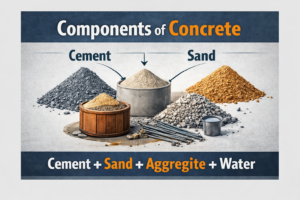
🧩 Main Components:
| Component | Function |
|---|---|
| Cement | Acts as a binder |
| Sand (Fine Aggregate) | Fills voids and improves workability |
| Coarse Aggregate | Provides strength and bulk |
| Water | Initiates chemical reaction (hydration) |
📌 Water-Cement Ratio (Very Important)
The strength of concrete depends heavily on the water-cement ratio.
- Lower ratio → Higher strength
- Higher ratio → Lower strength (but better workability)
👉 Ideal range: 0.4 – 0.6
🧪 Types of Concrete (With Uses)
Concrete is not just one material—there are many types based on application.
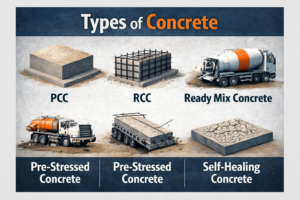
1. Plain Cement Concrete (PCC)
- No reinforcement
- Used in flooring, pavements
2. Reinforced Cement Concrete (RCC)
- Steel bars added for tensile strength
- Used in beams, slabs, columns
3. Ready Mix Concrete (RMC)
- Pre-mixed in plants
- Delivered to site
4. Prestressed Concrete
- High-strength concrete with pre-tensioned steel
- Used in bridges, flyovers
5. Self-Compacting Concrete (SCC)
- Flows without vibration
- Used in complex structures
6. Green Concrete (Emerging Trend 🚀)
- Eco-friendly materials
- Reduces carbon footprint
📊 Grades of Concrete Explained
Concrete grades represent compressive strength after 28 days.
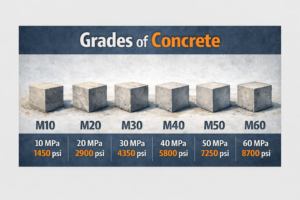
📌 Common Grades:
| Grade | Strength (MPa) | Typical Use |
|---|---|---|
| M5 – M15 | Low strength | PCC works |
| M20 | Standard grade | Residential buildings |
| M25 – M30 | Medium strength | RCC structures |
| M35+ | High strength | Bridges, heavy structures |
👉 Example:
M25 = 25 MPa compressive strength
🧮 Concrete Mix Ratio
The mix ratio defines how materials are combined.
📌 Common Mix Ratios:
| Grade | Cement : Sand : Aggregate |
|---|---|
| M15 | 1 : 2 : 4 |
| M20 | 1 : 1.5 : 3 |
| M25 | Design mix |
👉 Modern construction uses design mix instead of fixed ratios for accuracy.
🏗️ Uses of Concrete in Construction
Concrete is used in almost every part of construction:
🏢 Structural Uses:
- Foundations
- Columns
- Beams
- Slabs
🚧 Infrastructure:
- Roads
- Bridges
- Dams
- Airports
🏠 Residential:
- Flooring
- Walls
- Driveways
⚖️ Advantages of Concrete
- High compressive strength
- Durable and long-lasting
- Fire-resistant
- Versatile (can be molded into any shape)
- Low maintenance
⚠️ Disadvantages of Concrete
- Low tensile strength (needs reinforcement)
- Cracking due to shrinkage
- Heavy weight
- Requires curing time
🚀 Future of Concrete (2026 Trends)
- AI-based mix optimization
- Self-healing concrete
- Carbon-neutral concrete
- 3D-printed concrete structures
👉 These trends are reshaping the construction industry globally.
❓ FAQs
1. What is concrete made of?
Concrete is made of cement, sand, coarse aggregate, and water.
2. What is the strongest concrete grade?
High-strength concrete like M40 and above is considered very strong.
3. What is the difference between PCC and RCC?
PCC has no steel reinforcement, while RCC includes steel bars for tensile strength.
4. What is the ideal water-cement ratio?
The ideal ratio ranges between 0.4 to 0.6.
5. How long does concrete take to cure?
Concrete typically takes 28 days to achieve full strength.
