
ConstructionFeeds
- 42 comments
- 29th March, 2026
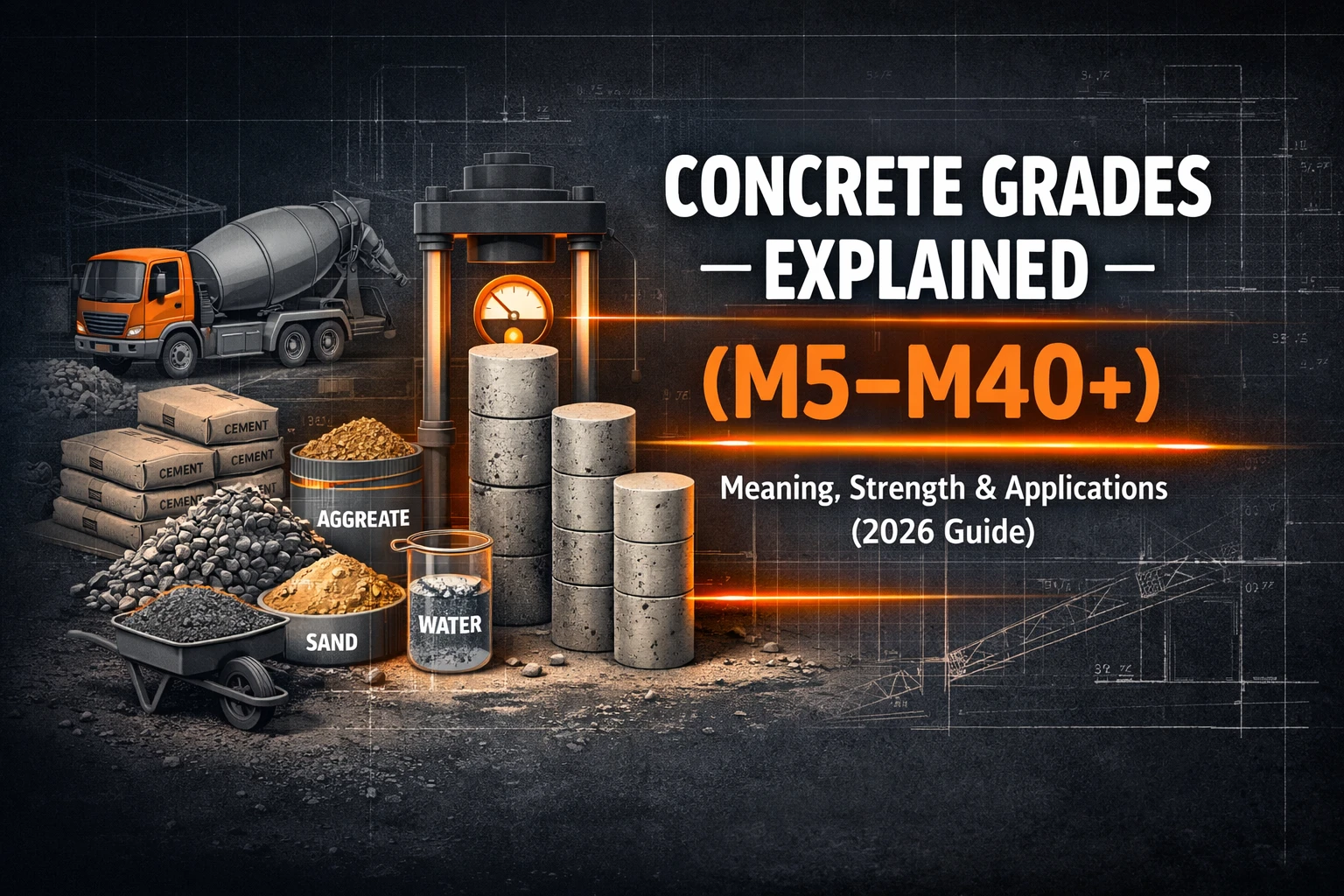
Concrete grades are the backbone of every construction project — from small homes to massive skyscrapers. Yet, many people don’t fully understand what M20, M25, or M30 actually mean.
In this guide, we’ll break down:
- What concrete grades are
- Meaning of M5 to M40+
- Strength vs application
- Residential vs commercial usage
- IS code standards
🧠 What Are Concrete Grades?
Concrete grades define the compressive strength of concrete after 28 days of curing.
👉 The “M” stands for Mix, and the number represents strength in MPa (Megapascals).
For example:
- M20 = 20 MPa strength
- M30 = 30 MPa strength
This helps engineers choose the right concrete based on load, durability, and structural requirements.
📊 Concrete Grades Chart (M5–M40+)
| Grade | Strength (MPa) | Mix Ratio (Nominal) | Typical Use |
|---|---|---|---|
| M5 | 5 MPa | 1:5:10 | Levelling, bedding |
| M7.5 | 7.5 MPa | 1:4:8 | Road sub-base |
| M10 | 10 MPa | 1:3:6 | Non-structural work |
| M15 | 15 MPa | 1:2:4 | Plain cement concrete |
| M20 | 20 MPa | 1:1.5:3 | Residential slabs |
| M25 | 25 MPa | Design Mix | RCC structures |
| M30 | 30 MPa | Design Mix | Heavy structures |
| M35+ | 35+ MPa | Design Mix | Commercial/high-rise |
🏗️ Meaning of Popular Concrete Grades
🔹 M10 Concrete
- Strength: 10 MPa
- Used for: Non-load-bearing structures
- Applications:
- Pathways
- Levelling surfaces
- Flooring base
👉 Not suitable for structural elements
🔹 M20 Concrete (Most Common)
- Strength: 20 MPa
- Standard mix: 1:1.5:3
- Applications:
- Slabs
- Beams
- Columns (small structures)
👉 Widely used in residential construction
🔹 M25 Concrete
Strength: 25 MPa
- Type: Design mix (not fixed ratio)
- Applications:
- RCC structures
- Foundations
- Columns
👉 Used in both residential & light commercial projects
🔹 M30 Concrete
- Strength: 30 MPa
- Applications:
- Multi-storey buildings
- Bridges
- Industrial structures
👉 Ideal for high-load-bearing elements
🔹 M35–M40+ Concrete
- Strength: 35–40+ MPa
- Applications:
- High-rise buildings
- Flyovers
- Infrastructure projects
👉 Used in commercial & mega construction
⚖️ Strength vs Application (Quick Breakdown)
| Grade Range | Strength Level | Application Type |
|---|---|---|
| M5–M15 | Low | Non-structural |
| M20–M25 | Medium | Residential |
| M30–M40 | High | Commercial |
| M40+ | Very High | Infrastructure |
🏠 Residential vs Commercial Usage
🏡 Residential Construction
- Common grades: M20, M25
- Used for:
- Slabs
- Beams
- Footings
👉 Balance of cost + strength
🏢 Commercial Construction
- Common grades: M30, M35, M40+
- Used for:
- High-rise structures
- Heavy load-bearing columns
- Infrastructure
👉 Focus on durability + load capacity
📘 IS Code References (India Standards)
Concrete grades in India follow:
- IS 456:2000 – Plain & Reinforced Concrete Code
- IS 10262 – Concrete Mix Design Guidelines
Key Rules:
- Minimum grade for RCC = M20
- Design mix required for M25 and above
- Water-cement ratio must be controlled
👉 These standards ensure safety, durability, and consistency
⚠️ Common Mistakes to Avoid
- ❌ Using low-grade concrete for structural work
- ❌ Ignoring curing time (28 days is critical)
- ❌ Incorrect mix ratios
- ❌ Not following IS codes
🧠 Final Thoughts
Choosing the right concrete grade is not just about strength — it’s about matching the material to the purpose.
- M20 → Perfect for homes
- M25 → Stronger structural support
- M30+ → Commercial & heavy-duty projects
If you get this wrong, you risk:
👉 Structural failure
👉 Increased cost
👉 Reduced lifespan
📌 FAQ
Q1. What does M20 concrete mean?
It means the concrete has a compressive strength of 20 MPa after 28 days.
Q2. Which concrete grade is best for house construction?
M20 is most commonly used for residential buildings.
Q3. What is the minimum grade for RCC?
As per IS 456:2000, the minimum grade is M20.
Q4. Is M25 better than M20?
Yes, M25 offers higher strength and durability.
